
Are trees boring? Do all trees look the same? Ever heard of the Rainbow tree? Or seen a tree where the fruits grow on the bark? And what if you could see the roots of the tree?
Thinking about and searching for information about trees is a great way to not only learn about nature but also to gain inspiration for art projects. The inspiration for this blog post came when I saw some beautiful trees on a website.
Like the Indian Rain Tree, which is shaped like an umbrella and is believed to have magic powers.

Lottas Trees- Rain Tree
Tree activities are great to use throughout the year, but they can also be part of Arbour Day celebrations. Arbour Day is celebrated to encourage people to plant trees and to care for trees. The date varies in different countries.
Trees grow slowly, and it is difficult to see how they are growing. But they are fascinating, and we found several interesting and unusual trees at Listverse. Like the Dragon Blood Tree with crimson sap.
We searched for information about why trees are important and what parts they have:
Trees are Important:
- provide a home for animals
- keep you cool
- food
- place to play -> tree houses
- prevent soil erosion
Parts of a Tree:
- leaves
- branches
- trunk
- bark
- roots
We found a very strange-looking tree where you could actually see the roots!
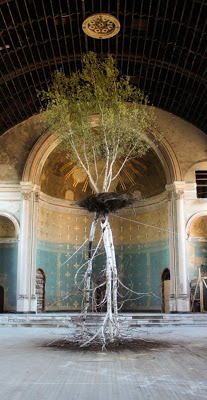
We looked at the shape of the trees, and we saw that trees could be shaped like:
- cones
- circles
- triangles
After we had collected lots of images, information, and explored the trees that grow where we live, we dived into some creative thinking. Trees may change the way they look during different times of the year. During winter, the trunks may look like this! And this photo gave us inspiration for making a sculpture.

Photo Rainbow Eucalyptos
Trees with colourful Roots and Trees that grow on Trees!
Ideas for art projects can be gained by twisting and turning information around. The overall aim with this and the previous blog post is to show how children can use information to learn about trees and to get their own ideas. Thus, rather than copying ideas, a child is provided with the opportunity to learn how to be creative and to think. These skills take time to develop but nurturing creativity and teaching children to think is rewarding for the children as they grow in confidence in their own abilities.
Mind maps can be used to collect information, and throughout the year, ideas and information can be added to the mind map. This approach can be used to explore a range of topics. It is important to remember that there is no need to collect this much information – the mind map below should be seen as an inspiration for approaching a topic.
Some ideas that we got when we talked about trees was to make:
- Tree Sculptures – these sculptures could be made by combining words such as circus, dream or love
- Make trees with colourful roots.
- Trees that grow on a tree.
Thinking and creative skills that are used to gain these ideas are:
- Breaking patterns – usually trees are drawn with colourful treetops
- Turing things around, upside down – focusing on things that are usually not shown in painting like roots which are covered in soil. We also made the light come from underneath in the photo above to highlight the idea.
- Inserting things in new places – inserting a tree in a tree, this idea popped up when we saw that plants and animals live in trees
- Inventing new forms – Love trees, Circus Trees, Dream Trees

Frequently Asked Questions
What is biomimicry?
Biomimicry is the practice of looking to nature for solutions, then applying what we learn to design and problem-solving. Instead of inventing from scratch, it means studying how plants, animals, and ecosystems have already solved a challenge — like staying cool, collecting water, or absorbing carbon — and adapting that strategy for human use.
How does biomimicry help address climate change?
Nature has been adapting to extreme conditions for billions of years, so many organisms already hold working solutions to problems we now face at a larger scale — cooling buildings without electricity (termite mounds), collecting water in drought (the Namib beetle), protecting coastlines from storms (mangrove roots), and capturing carbon (corals, forests, kelp). Biomimicry means studying those solutions and applying the same principles to human design.
How can children get involved in biomimicry?
Children don’t need special training to think like a biomimicrist — just curiosity and a habit of asking “how does nature solve this?” Simple ways to start include a backyard scavenger hunt for nature’s patterns, a “design-an-animal” challenge for a changing climate, or building a small model (like a passive-cooling structure or a water collector) inspired by something they’ve observed outdoors.
Is biomimicry only for scientists and engineers?
No — biomimicry is as much a mindset as a profession. Anyone can practice it by observing nature closely and asking design questions. Professional biomimicry practitioners apply it in architecture, materials science, and engineering, but the same core skill — careful observation followed by “what if we built it that way?” — is exactly what this post’s classroom and family activities are designed to build in children.

Åsa Jomård
In 2015, Åsa completed a course in Biomimicry: A Sustainable Design Methodology at Minneapolis College of Art and Design. With over 10 years of experience exploring nature for inspiration and as a former member of Ben, Biomimicry Education Network, she brings both academic background and creative teaching experience to her work. Her materials seamlessly integrate stories, nature observations, and design challenges, making them perfect for inquiry-led learning in early primary contexts.
AI was used as a Thinking Partner.