
Almost too perfect to be true. Like an artist has dreamed up some geometrically perfect and correct plants or sand dunes. Nature’s symmetry is a subject that has fascinated philosophers, mathematicians, artists, architects, and physicists.
This is the heart of biomimicry — nature’s patterns aren’t just pretty; they’re often the most efficient shape for a job, whether that’s a leaf collecting sunlight, a shell resisting pressure, or a giant leaf staying afloat on water.
What you’ll learn:
- Why nature repeats certain patterns again and again — spirals, stripes, symmetry
- How an armadillo’s shell and a giant lily pad connect to real design ideas
- A simple pattern-hunting activity to try outdoors
Patterns can be found everywhere in nature, and walking around looking for them is a fun, imaginative activity that inspires curiosity and scientific as well as artistic investigation.

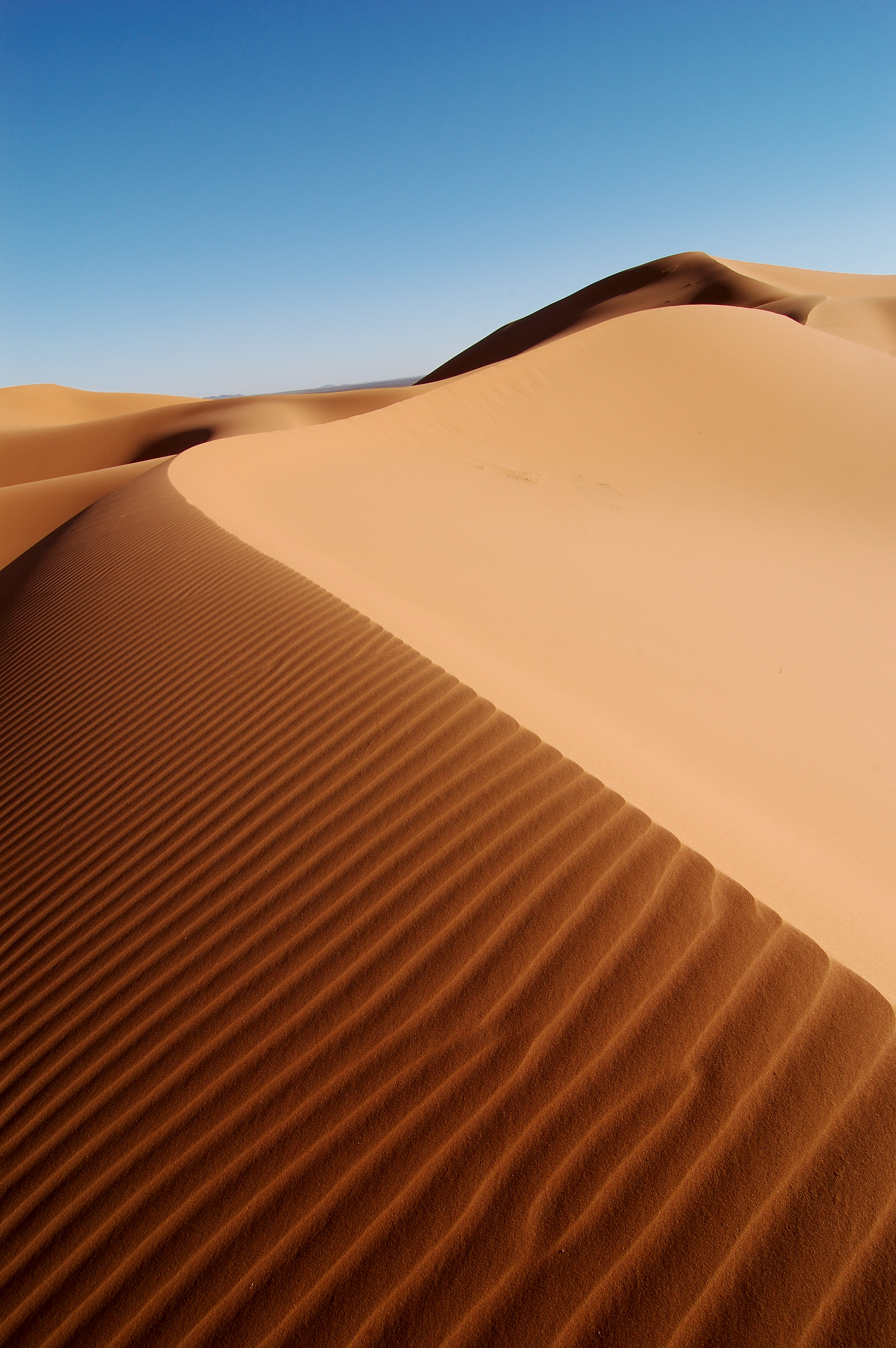
As the wind blows leaves in autumn, we can see different patterns in how they pile up — clustering among stones, drifting into spirals at the edge of a path. Patterns like these can be found right in your own park or garden. Perhaps they’re not as mesmerising as the wind-carved patterns in desert sand dunes, but they’re still fascinating enough to make children stop and look closer.

Photo: Wikimedia
Spirals, stripes, and segments — why nature repeats itself
There might not be an armadillo in your garden, but you’ve probably spotted patterns on butterfly wings, caterpillars, or the ridges on a snail shell. Here’s why some of nature’s most common patterns show up again and again:
- Segmented shells, like an armadillo’s, are made of overlapping plates rather than one solid piece. This gives the animal flexibility to curl and move while still staying protected — the same principle behind chainmail and some modern flexible armour.
- Radiating veins, like those on a giant Amazon lily pad, spread out from the centre like the spokes of a wheel. This structure lets a single leaf grow enormous — sometimes over two metres across — while staying strong enough to float and support weight, including, famously, a small child.
- Spirals, seen in pinecones, snail shells, and sunflower seed heads, pack the most material into the smallest space. It’s an efficient way to grow without wasting room or energy.

.jpg)
Some patterns are perfect for playing “What if“:
What if you could climb on a playground shaped like a giant Amazon lily pad — with ridges radiating out to hold your weight the way the leaf holds its own?
What if you could dive into a structure shaped like a giant Dahlia, its petals spiralling in perfect layers?


Try This: Pattern Hunt
Take a short walk — a garden, a park, or even just around the block — and look for three kinds of patterns:
- Spirals: pinecones, snail shells, curled ferns
- Stripes: tree bark, feathers, insect markings
- Repeating shapes: leaves, honeycomb, flower petals
Sketch or photograph what you find. Then ask: why might this pattern help the plant or animal survive? A striped pattern might help with camouflage. A spiral might help something grow efficiently. A repeating shape might add strength.
So take some time to explore, and you might find the most fantastic, mind-boggling patterns exactly where you least expect them.
Nature might seem filled with symmetry, so it’s easy to believe everything follows a perfect pattern. But the breaking of perfect symmetry matters too — it’s nature’s way of turning identical things into something distinct. We explore that idea further in Symmetry in Nature.
The book Seeing Symmetry by Loreen Leedy is a great starting point for exploring these ideas — a visual demonstration of symmetry rather than a story, filled with pattern-rich pictures.

Armadillo Shell
Frequently Asked Questions
What is biomimicry?
Biomimicry is the practice of looking to nature for solutions, then applying what we learn to design and problem-solving. Instead of inventing from scratch, it means studying how plants, animals, and ecosystems have already solved a challenge — like staying cool, collecting water, or absorbing carbon — and adapting that strategy for human use.
How does biomimicry help address climate change?
Nature has been adapting to extreme conditions for billions of years, so many organisms already hold working solutions to problems we now face at a larger scale — cooling buildings without electricity (termite mounds), collecting water in drought (the Namib beetle), protecting coastlines from storms (mangrove roots), and capturing carbon (corals, forests, kelp). Biomimicry means studying those solutions and applying the same principles to human design.
How can children get involved in biomimicry?
Children don’t need special training to think like a biomimicrist — just curiosity and a habit of asking “how does nature solve this?” Simple ways to start include a backyard scavenger hunt for nature’s patterns, a “design-an-animal” challenge for a changing climate, or building a small model (like a passive-cooling structure or a water collector) inspired by something they’ve observed outdoors.
Is biomimicry only for scientists and engineers?
No — biomimicry is as much a mindset as a profession. Anyone can practice it by observing nature closely and asking design questions. Professional biomimicry practitioners apply it in architecture, materials science, and engineering, but the same core skill — careful observation followed by “what if we built it that way?” — is exactly what this post’s classroom and family activities are designed to build in children.

Åsa Jomård
In 2015, Åsa completed a course in Biomimicry: A Sustainable Design Methodology at Minneapolis College of Art and Design. With over 10 years of experience exploring nature for inspiration and as a former member of Ben, Biomimicry Education Network, she brings both academic background and creative teaching experience to her work. Her materials seamlessly integrate stories, nature observations, and design challenges, making them perfect for inquiry-led learning in early primary contexts.
AI was used as a Thinking Partner.
One thought on “Patterns Everywhere! Be Inspired”